
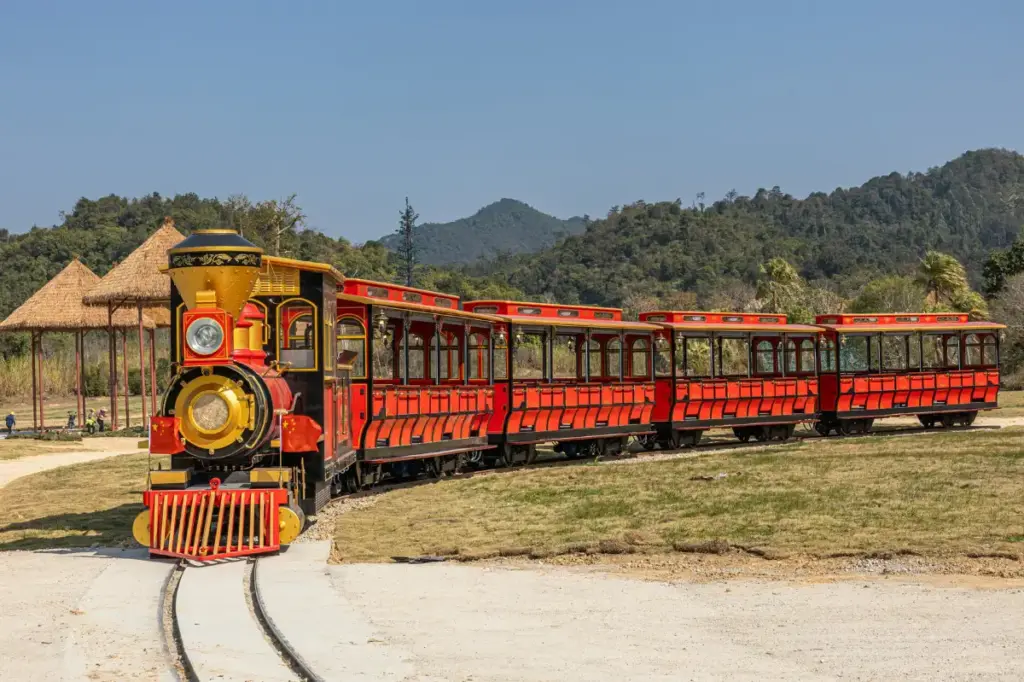
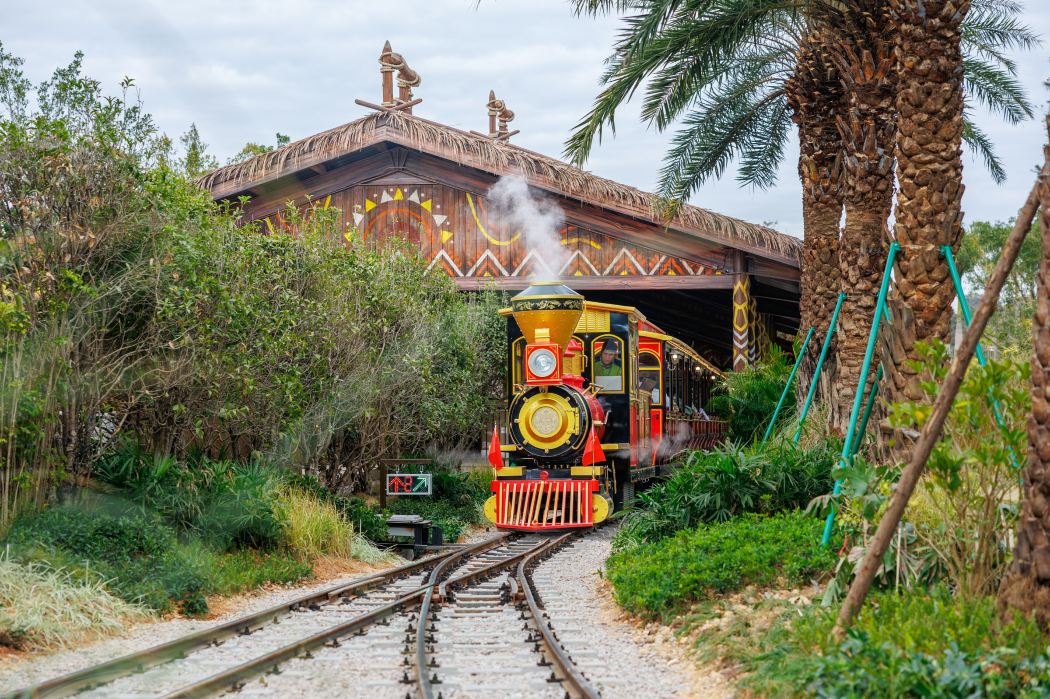
If every theme park has one attraction that defines it, the steam train is Qingyuan Chimelong Forest Kingdom’s. The vintage red locomotive — a heritage-style engine with open observation carriages — pulls out of its station near the main gate and circles the Greater Africa savanna, passing giraffe herds, zebra groups, wildebeest and ostriches in open, fence-to-horizon landscapes. It is part ride, part safari, part time machine, and it is included with regular park admission.
We have ridden it at 10:00 in the morning mist and again in late-afternoon gold, in sunshine and in drizzle. This guide covers the route, which animals you realistically see from which side of the carriage, when to ride, and the truck-tour upgrade for visitors who want to get closer. Facts were checked against the park’s official Trip.com listing in November 2026.
⚡ Quick answer: Ride the steam train first thing at 10:00, sit on the right-hand side facing the open savanna, and keep your camera ready for the giraffe herds under the thatched shelters. If you want a narrated, closer encounter, upgrade to the Wild Truck – Exploring Africa study tour (around US$29.66 on Trip.com).
🚂 The Train Itself: A Working Piece of Nostalgia 🌿
The locomotive is styled like an early-20th-century narrow-gauge engine, complete with a chimney that puffs on the climbs and a brass-bright cowcatcher. The carriages are open-sided with individual rows of seats and a canopy roof, so the savanna is always in unobstructed view — no glass, no fences between you and the landscape. On cool mornings the steam and the forest mist mix into the single most atmospheric photograph in the park.
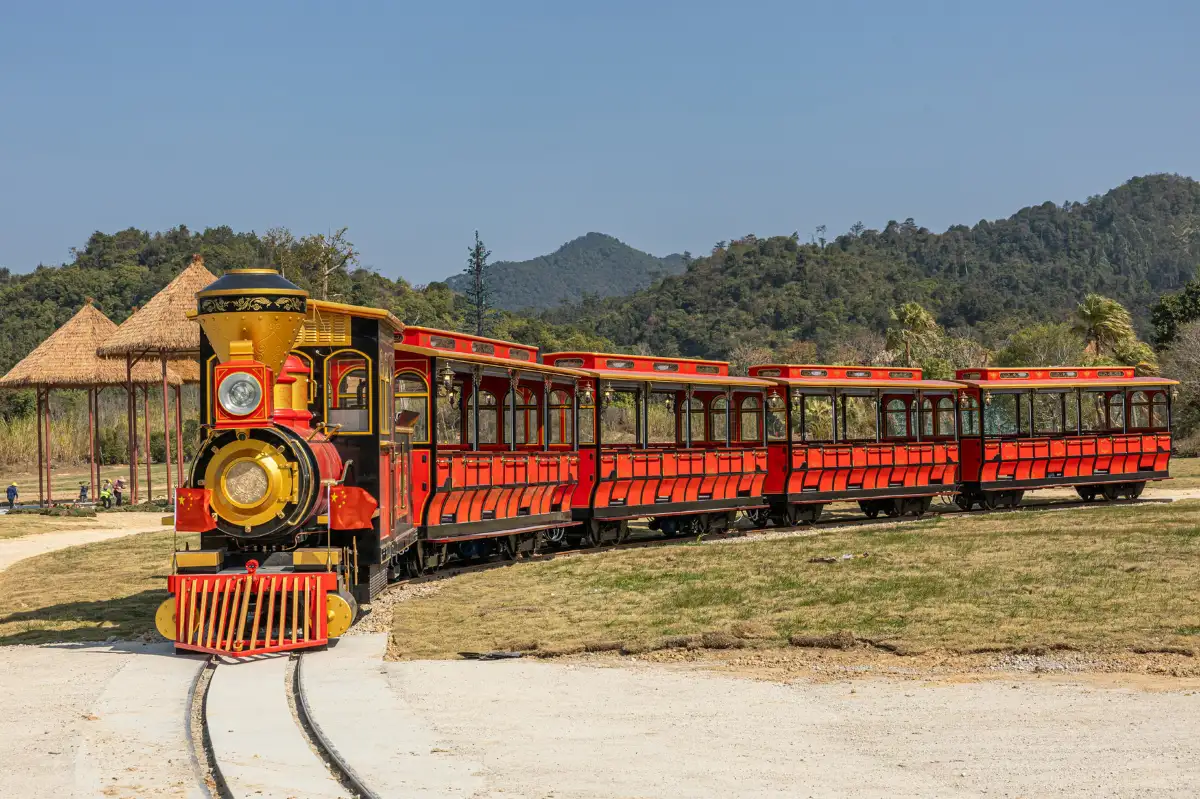
The station sits near the park entrance, signed 蒸汽小火车站口 (Steam Mini-Train Station). You cannot really miss it: the gate is timber-built in the same African-lodge style as the rest of the zone, and the platform fills quickly at opening time.
🗺️ The Route: What You Actually See 🦓
The loop crosses the Greater Africa zone — the park’s largest open landscape — in roughly 25–30 minutes. Nothing is guaranteed with animals, of course, but across our rides this is the honest hit list:
| Sector | Likely Sightings | Photo Notes |
|---|---|---|
| Departure — forest edge | Tree cover, wetland birds, the park skyline | Shoot forward down the track for the classic train-through-forest shot |
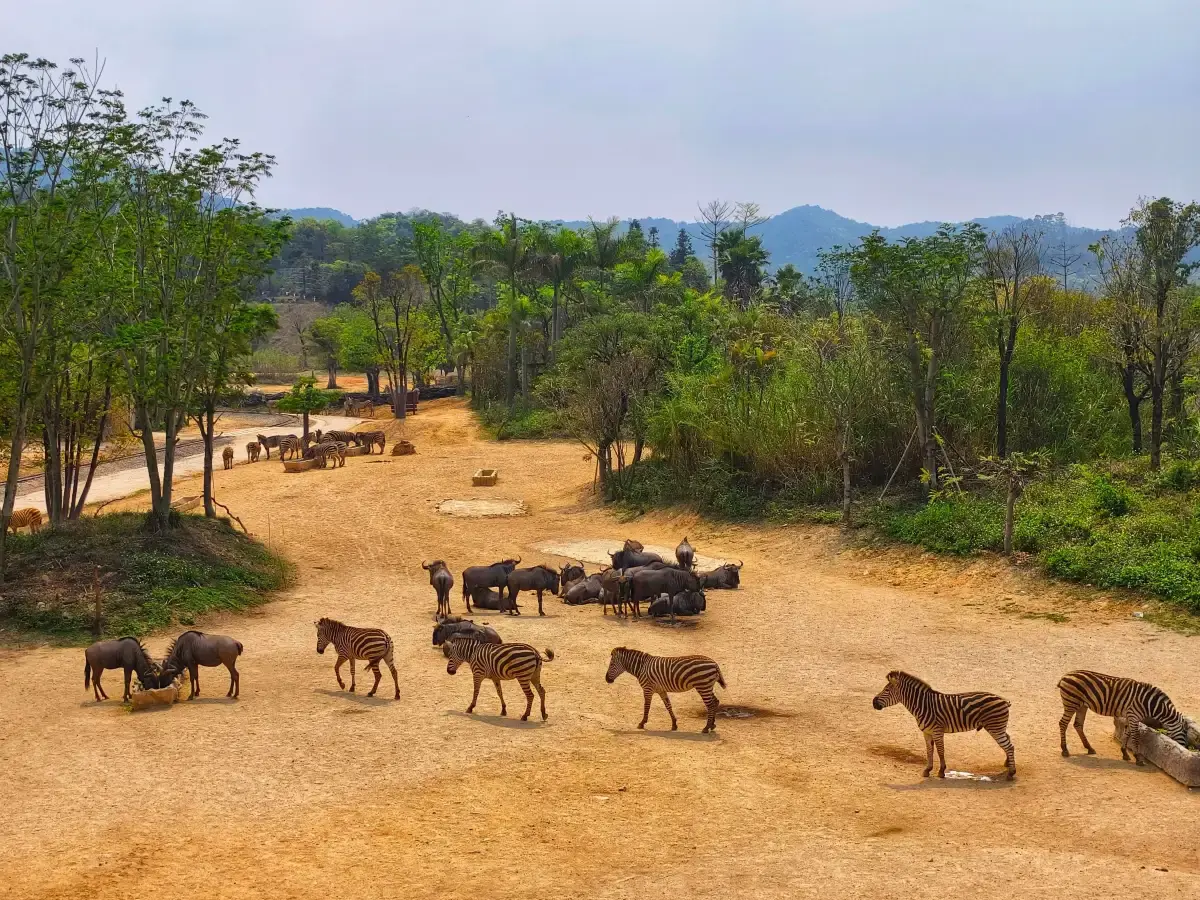
| Open savanna west | Giraffe herds, zebras, wildebeest | Longest sightlines; right-side seats win here |
| Thatched shelter zone | Giraffes at the feeders, occasional rhinos at a distance | The postcard composition — animals under straw umbrellas |
| Waterhole curve | Ostriches, waterbirds, elephants sometimes in the pool | Slowest section, best for video |
| Return — treeline | Shade-loving antelope, the Ferris Wheel ahead | Filming the locomotive curving ahead of you always works |
🪑 Which Side to Sit On (and Why It Matters)
The loop runs counter-clockwise, which puts the widest savanna views on the right-hand side as the train departs. That is where the giraffe herds and the shelter zone spend most of their day. The left side has its moments — the waterhole, the forest close-ups — but if you are choosing one, choose right.
Two seating tactics worth knowing:
- First row of the first carriage: unbroken views forward, and the locomotive steam blows away from you on most bends. Best for photographers.
- Last carriage: you see the whole train curving through the landscape — the shot everyone tries to recreate after seeing the park’s promotional photos.
⏰ Best Time to Ride: 10:00 Sharp (or After 15:30)
Animals set the schedule here, not the park. Grazers feed hardest in the first cool hours after the 10:00 opening, so the earliest departure gives you the most movement — heads up, herds walking, interactions between animals. By midday, heat sends everything into the shade and the savanna goes quiet.
The second window is after 15:30, as temperatures fall and afternoon feeding begins. This is also when the light turns warm and low — the savanna photographs best of the whole day. Between the two, we give the edge to the morning for animal activity and the late afternoon for photography; with a full day in the park, ride twice.
Queue logic favors both windows too: tour groups ride the train in the 11:00–14:00 band, and a full three-carriage load can mean a 20–30 minute wait for the next departure. At 10:00 and after 15:30 we have usually walked straight on.
🚚 Want Closer? The Wild Truck – Exploring Africa Upgrade 🐘
The train keeps a respectful distance from the animals — part of its charm and its limits. If you want keeper-level narration and closer approaches, the park offers the Wild Truck – Exploring Africa study tour, an open safari truck led by a guide, listed at around US$29.66 on the park’s Trip.com page. Groups are small, the route pushes deeper into the habitat sections, and guides answer the questions children actually ask. For families with animal-mad kids, it is the best-value add-on in the park.
Our advice: do both. The train for the panorama and the photographs, the truck for the close encounters and the science. Book both on 트립닷컴 when you buy admission so the tour slot is locked before you arrive.
👧 Riding with Children: The Honest Notes
- The open carriages suit children perfectly — no doors, no windows to fight, and slow enough that even toddlers stay settled. Keep small ones seated on the inside seats as the carriage sways gently on bends.
- Feeding from the train is not allowed, and keepers will stop it. Save the hand-feeding for the Giraffe Savanna platform: our animal encounters guide covers it in detail.
- Noise-sensitive children: the whistle genuinely announces departures. A heads-up before the first whistle saves tears.
- Strollers: fold them and stow them in the luggage rack at the carriage end, or leave them at the station’s stroller parking.
📸 Photographing the Train: Three Setups That Work 📷
- The curve shot: from the ground after your ride, walk to the bend just past the station (outside the track fence, in guest areas) and shoot the train curving with the Ferris Wheel behind — the signature frame of the whole park.
- The steam frame: at the 10:00 departure, stand downwind of the platform and catch the locomotive against its own steam. Backlit, the steam glows.
- The rider’s panorama: from the first carriage, wide lens, shoot the savanna sweeping past with the carriage rail in the lower frame — it reads instantly as “safari by train.”
More locations and timing tricks — including the misty-morning giraffe fields — are in our 15 best photo spots guide.
🧭 Fitting the Train into Your Day
In a one-day plan, the train is your 10:00 anchor, followed by giraffe feeding at 11:00 and a show after lunch — the full sequence is laid out in our hour-by-hour itinerary. On a two-day resort weekend, ride the train on your theme-park day and give the safari park its own day: the 2-day resort triangle itinerary shows how they complement each other.
Tickets: the train is included in standard admission (from about US$37.99 adult on Trip.com with current discounts). Entry rules require your original passport and name-matched tickets — details in our ticket guide.
📋 The Animal-Spotting Checklist: Scorecard for the Loop 🦁
Turn the ride into a family game — print or screenshot this checklist and tick what your carriage actually sees. Across our rides, the top rows are near-certain and the bottom rows are genuine bonuses:
| Likelihood | Animal | Where on the Loop |
|---|---|---|
| Near-certain | Giraffes | Shelter zone, right side |
| Near-certain | Zebras | Open savanna, both sides |
| Near-certain | Wildebeest | Savanna mid-loop |
| Near-certain | Ostriches | Treeline and waterhole curve |
| Very likely | Antelope species | Grass edges, left side shade |
| Likely | African elephants | Paddock near the waterhole |
| Likely | White rhinos | Far sections, distance |
| Possible | Waterbirds and storks | Wetland edges |
| Possible | Birds of prey overhead | Thermals above the savanna |
Seven ticks is a good ride; nine is a lucky morning. Children treat this like a bingo card, which conveniently keeps their eyes on the landscape instead of their shoes — and the game teaches them to scan habitat edges, which is genuinely how you spot wildlife anywhere.
⚖️ Train vs. Truck vs. Walking: Which Safari Is Yours? 🤔
Greater Africa can be experienced three ways, and they are complements, not competitors:
| 🚂 Steam Train | 🚚 Wild Truck Tour | 🚶 Savanna Boardwalks | |
|---|---|---|---|
| Cost | Included with admission | ≈ US$29.66 | Included |
| Duration | 25–30 min | About an hour | Your pace |
| Distance from animals | Respectful, panoramic | Close, guided | Fence-line views |
| Narration | None | Keeper-led, question-friendly | Signage |
| Photography | Moving platform, big vistas | Stops for close frames | Slow, deliberate |
| Best for | Everyone, first thing | Animal fans, kids with questions | Photographers, slow travelers |
Our honest ranking for a one-day visit: train first at 10:00, boardwalks mid-morning, truck as the paid upgrade if the group is animal-mad. Two-day visitors split them naturally — train with the theme-park day, truck with the safari day (the weekend plan).
♿ Comfort and Accessibility Notes 🧑🦽
- Boarding: carriages have a step up and a handrail; staff assist actively at the platform. Foldable wheelchairs fit in the luggage rack space — tell the platform staff before boarding.
- Ride smoothness: the loop is slow with gentle bends — suitable for elderly travelers and pregnancy, and calmer than any coaster in the park. The whistle and occasional steam puff are the only surprises.
- Weather exposure: carriages are covered but open-sided — hats and sunscreen apply even at 10:00, and a light layer helps in December–February wind.
- Hearing the announcement: departure calls are audible at the station but not across the park; plan to be at the platform five minutes ahead rather than relying on last-minute calls.
🔁 Ride It Twice: The Two-Pass Strategy 🔂
The train is included in admission, so riding twice costs nothing but 30 minutes — and the two passes genuinely show you two different parks:
- Pass one, 10:00: animal-focused. Cool air, active herds, feeding behavior. Sit right side, cameras down for the first five minutes, just watch.
- Pass two, after 15:30: light-focused. Low sun turns the savanna amber, animals regroup for evening feeding, and the shadows make the thatched shelters photogenic. Same seats, different world.
Between the passes, the savanna boardwalks give you the slow, fence-line version of the same landscape — giraffe eye-level moments happen at the platform, not from the train, so keep the animal encounters guide handy for what to do on foot between laps.
❓ Frequently Asked Questions
Is the steam train included in the ticket price?
Yes — the Greater Africa steam train loop is part of standard Forest Kingdom admission. The only costs beyond it are optional experiences like the giraffe feeding or the Wild Truck study tour (around US$29.66).
How long is the ride?
Roughly 25–30 minutes for the full loop, plus boarding time. Factor about 40 minutes door to door if a departure is boarding as you arrive.
Can animals approach the train?
Animals roam freely through the savanna and sometimes graze meters from the tracks, but the train keeps moving and does not stop mid-loop. For guaranteed close encounters, choose the guided Wild Truck tour instead.
Does the train run in the rain?
Typically yes in light rain — the canopy roof covers the seats. In heavy rain, thunderstorms or high winds, operations can pause for safety; re-check at the station or the gate board that day.
Is there a bad seat?
No, but there is a best side: the right-hand side from departure faces the open savanna and the giraffe shelter zone. Left-side riders see the waterhole and forest edge. Photographers should target the first carriage, first row.
🌟 마지막 생각
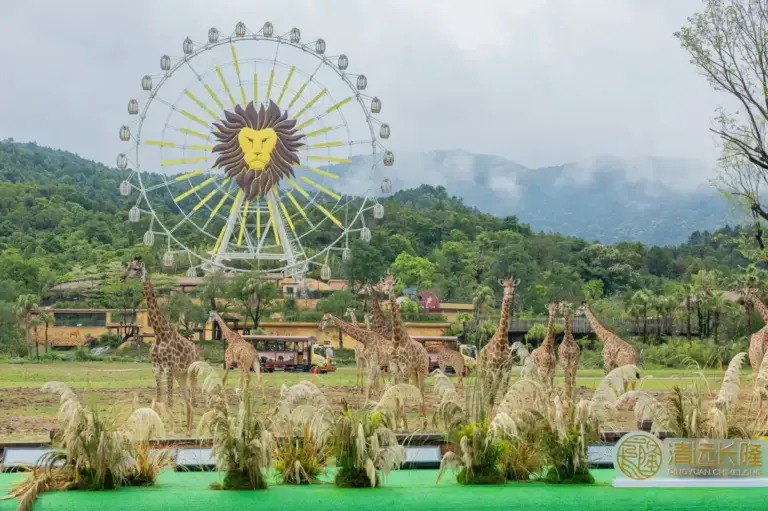
Every park has a postcard, and Qingyuan Chimelong’s is a red steam train curving through an African savanna with a lion-faced Ferris Wheel on the skyline. The ride costs nothing extra, takes half an hour, and delivers more “wow” per minute than anything else behind the gate. Ride it first, ride it again in golden light, and let it be the spine of your day.
댓글